
AIOps: How AI Is Transforming DevOps in 2026
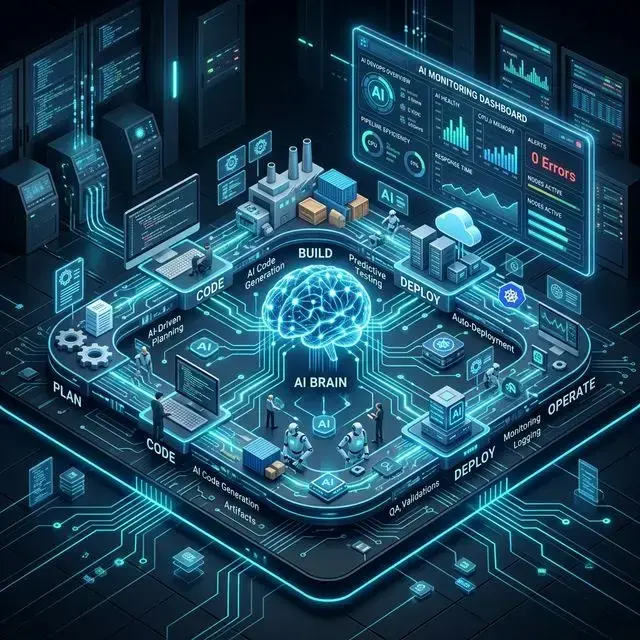
AIOps: How AI Is Transforming DevOps in 2026
Modern cloud systems generate millions of metrics, logs, and trace events every second. As microservice architectures expand across multi-cloud environments, human operators can no longer manually analyze telemetry streams to detect performance degradation or diagnose outages.
Enter AIOps (Artificial Intelligence for IT Operations). By combining machine learning, natural language processing, and automated event correlation, AIOps transforms raw telemetry into actionable intelligence, enabling predictive incident prevention and intelligent operations.
What Is AIOps?
AIOps is the application of artificial intelligence and machine learning algorithms to automate and enhance IT operations, monitoring, and incident response workflows. Coined by Gartner, AIOps bridges the gap between massive telemetry data volume and human operational capacity.
Instead of relying on static alert thresholds that trigger false positives, AIOps establishes dynamic behavioral baselines across systems, detecting anomalies long before critical outages impact end users.
How AIOps Works
An enterprise AIOps platform operates through continuous, real-time data ingest and machine learning pipelines:
Data Ingestion (Logs, Metrics, Traces, Events) → Data Cleaning & Deduplication → Pattern Recognition & Anomaly Detection → Root Cause Analysis → Automated Remediation / Escalation
- Data Ingestion: Ingests structured and unstructured data from monitoring tools, cloud APIs, container registries, and application logs.
- Data Reduction: Deduplicates redundant alerts and filters out operational noise using natural language grouping algorithms.
- Pattern Analysis: Uses supervised and unsupervised machine learning models to detect abnormal resource trends and system correlation.
- Root Cause Analysis: Maps dependencies across microservices to isolate the precise commit, container, or configuration change causing failure.
- Actionable Insights & Remediation: Recommends remediation steps to engineers or executes pre-approved automated recovery runbooks.
AIOps vs Traditional Monitoring
| Feature | Traditional Monitoring | AIOps Observability |
|---|---|---|
| Detection Mechanism | Static thresholds (e.g., CPU > 85%) | Dynamic machine learning baselines |
| Alert Fatigue | High (hundreds of redundant alerts) | Low (correlated incident alerts) |
| Analysis Speed | Manual log searching (hours) | Automated root-cause isolation (seconds) |
| Operational Focus | Reactive incident response | Proactive & predictive prevention |
AIOps Use Cases
Anomaly Detection
AIOps models continuously learn baseline system behaviors, flagging statistical anomalies such as sudden latency spikes or abnormal database connection spikes before thresholds fail.
Incident Detection
Groups related symptoms across microservices into a single unified incident summary, eliminating duplicate PagerDuty notifications.
Root Cause Analysis
Automates topology mapping to trace cascading failures back to the specific root cause service or failed deployment.
Alert Correlation
Correlates thousands of raw telemetry events into context-rich incidents using topological and temporal algorithms.
Predictive Operations
Forecasts disk capacity exhaustion, memory leaks, and traffic overload hours before system degradation occurs.
Automated Remediation
Executes self-healing scripts for routine tasks—such as restarting unresponsive pod replicas or clearing cache allocations—with audit logging.
AIOps Architecture
An enterprise AIOps architecture sits above traditional observability stacks to orchestrate intelligent operations:
Observability Data (Prometheus, Datadog, ELK, Jaeger)
                      │
                      ▼
            AIOps Intelligence Engine
      (Data Processing & ML Models)
                      │
           ┌──────────┴──────────┐
           ▼                     ▼
  Automated Remediation    Incident Escalation
  (Self-Healing Scripts)  (Slack, PagerDuty)
AIOps and Observability
Observability provides the raw telemetry data (Metrics, Logs, Traces), while AIOps provides the intelligence to interpret that data in real time. Without strong observability baselines, AIOps algorithms lack the necessary data quality to generate accurate predictions.
Benefits and Limitations
While AIOps delivers significant reduction in Mean Time to Resolution (MTTR), organizations must maintain a balanced operational model:
- Benefits: Drastically reduces alert fatigue, accelerates incident triage, improves uptime, and optimizes cloud resource usage.
- Limitations & Human Approval: AI models cannot automatically resolve every complex architectural outage. High-risk actions—such as schema migrations, production rollbacks, or cluster teardowns—must require human approval before execution.
Implementing AIOps
- Establish Robust Observability: Ensure metrics, logs, and distributed tracing are centralized.
- Clean Telemetry Data: Standardize log formats (JSON) and label tags across services.
- Start with Alert Noise Reduction: Implement AIOps alert correlation first to eliminate alert fatigue.
- Incorporate Human-in-the-Loop Automation: Trigger automated remediation only for verified low-risk tasks while requiring engineer approval for critical actions.
Organizations exploring AI-powered operations can work with our AI & Cloud Consulting Services team to evaluate suitable automation and observability approaches. For ongoing infrastructure monitoring and managed operational support, explore our Managed DevOps & Cloud Services.
Frequently Asked Questions
What is AIOps?
AIOps stands for Artificial Intelligence for IT Operations. It refers to using machine learning and AI algorithms to analyze IT telemetry data, automate anomaly detection, correlate alerts, and accelerate root-cause analysis.
How does AIOps differ from traditional monitoring?
Traditional monitoring uses static rule-based thresholds and produces high alert noise. AIOps uses dynamic machine learning models to detect real anomalies, group related alerts, and isolate root causes automatically.
Can AIOps fix incidents automatically?
AIOps can execute automated self-healing scripts for routine, low-risk issues (e.g., clearing temporary caches or restarting pods). However, complex architectural issues require human engineering approval.
What telemetry data does AIOps use?
AIOps ingests system metrics, application logs, distributed traces, network flow logs, CI/CD deployment events, and incident history data.
Learn AIOps & DevOps Engineering
Want to master modern observability, automation, and cloud management? Explore our hands-on DevOps Training Programs or contact our enterprise team for Managed DevOps Services.
About NexGenium AI Team
AI & Machine Learning Solutions ArchitectsSpecialists in generative AI models, Retrieval-Augmented Generation (RAG), vector database engineering, and intelligent business process automation.