How to Choose the Right Software Development Company in 2026
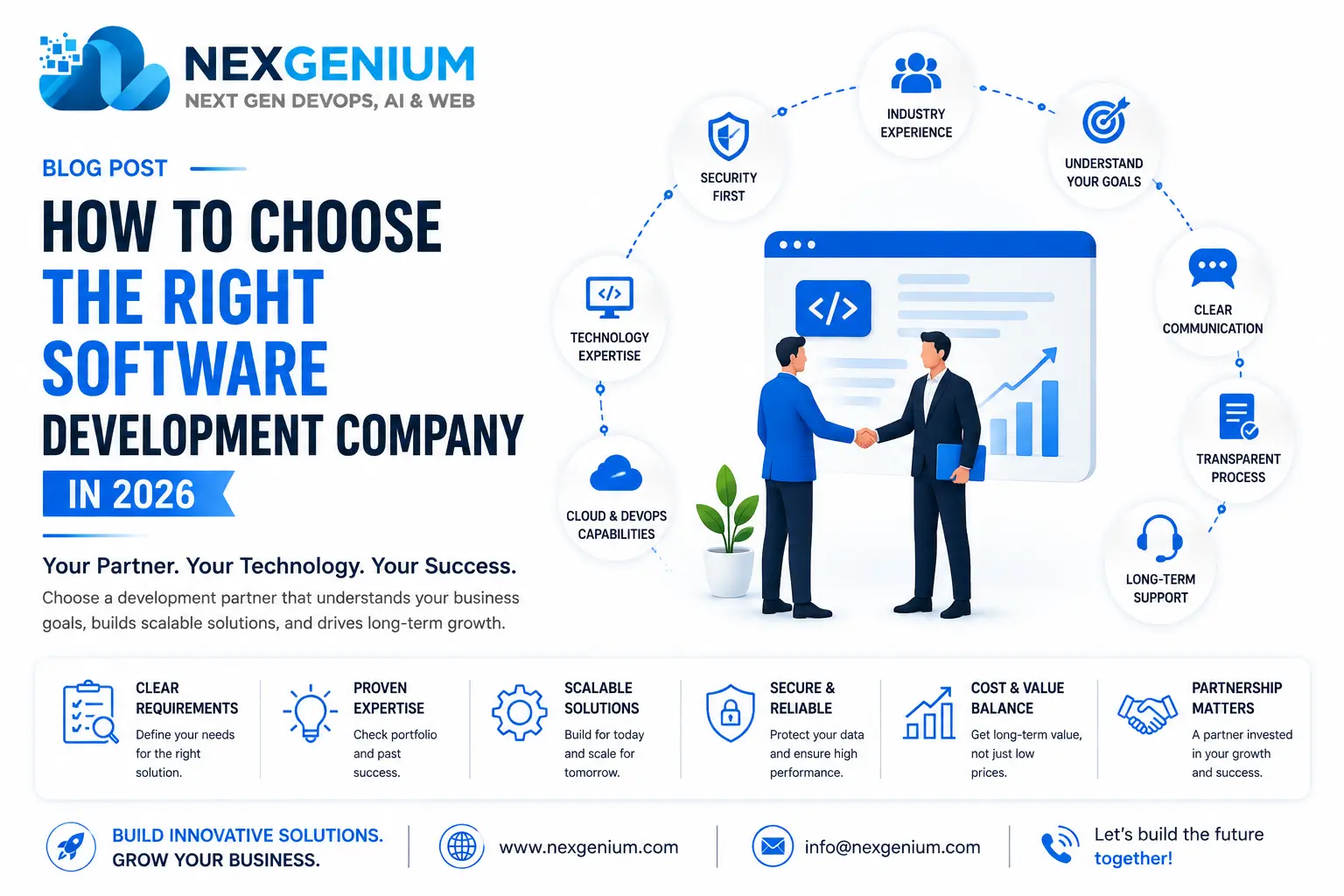
How to Choose the Right Software Development Company in 2026
Choosing a software development company is one of the most important technology decisions a business can make.
Whether you want to build a SaaS platform, e-commerce application, mobile app, customer portal, AI solution, internal business system, or completely new digital product, the technology partner you choose can directly impact your cost, timeline, security, scalability, and long-term growth.
The challenge is that there are thousands of software development companies offering similar services.
So how do you identify the right one?
This guide explains the most important factors businesses should evaluate before selecting a software development partner.
Why Choosing the Right Technology Partner Matters
Software development is not simply about writing code.
A successful software project requires:
- Business analysis
- Product architecture
- UI/UX design
- Development
- Testing
- Cloud infrastructure
- Security
- DevOps
- Deployment
- Monitoring
- Maintenance
- Continuous improvement
A company may have excellent developers but still deliver a poor project if requirements, architecture, communication, testing, or deployment are handled incorrectly.
The right technology partner should understand both:
Your Business Goals
and
Your Technology Requirements
1. Understand What You Actually Need
Before contacting a software development company, clearly define your requirements.
Ask yourself:
- What problem are we solving?
- Who will use the application?
- What features are essential?
- What is the expected number of users?
- Do we need a web application or mobile application?
- Do we need AI integration?
- Does the application need cloud infrastructure?
- Do we need third-party integrations?
- What is our expected launch timeline?
You don't need a perfect technical specification before contacting a development company.
A good technology partner should help transform your business requirements into a technical roadmap.
2. Look for Relevant Industry Experience
Don't select a software company simply because it knows React, Node.js, PHP, Python, or another programming language.
Look for experience solving problems similar to yours.
For example, if you're building:
SaaS Platform
Look for experience with:
- Multi-tenant architecture
- Authentication
- Subscription billing
- APIs
- Cloud infrastructure
- Scalability
E-Commerce Platform
Look for:
- Payment gateways
- Product catalogs
- Order management
- Inventory
- Security
- Performance optimization
AI Application
Look for:
- LLM integration
- AI APIs
- AI Agents
- RAG
- Vector databases
- Workflow automation
- AI security
Industry and architecture experience can be more valuable than simply knowing a particular programming language.
3. Evaluate Their Technology Stack
Modern software development increasingly involves multiple technologies working together.
Depending on your project, your technology partner may need expertise in:
Frontend
- React
- Next.js
- Angular
- Vue.js
Backend
- Node.js
- Python
- Java
- PHP
- .NET
Databases
- PostgreSQL
- MySQL
- MongoDB
- Redis
Cloud
- AWS
- Azure
- Google Cloud
DevOps
- Docker
- Kubernetes
- Jenkins
- GitHub Actions
- Terraform
AI
- Large Language Models
- AI APIs
- AI Agents
- RAG
- Workflow Automation
The technology stack should be selected based on your business requirements—not simply because a technology is trending.
4. Ask About Their AI Capabilities
AI is changing how modern software is built and operated.
Businesses are increasingly moving from AI experimentation toward integrating AI into actual products and workflows. Current industry coverage also points toward growing demand for AI implementation, automation, and integration expertise.
When evaluating a software development company, ask:
- Can you integrate AI into existing applications?
- Can you build AI-powered workflows?
- Can you develop AI Agents?
- Can you integrate LLM APIs?
- Can you connect AI with business databases?
- Can you automate repetitive workflows?
- How do you handle AI security and data privacy?
A development partner with both software engineering and AI expertise can help you avoid building disconnected systems.
5. Check Their Cloud & DevOps Expertise
Building an application is only one part of the project.
You also need to deploy and operate it reliably.
A strong software development partner should understand:
- AWS
- Azure
- GCP
- Docker
- Kubernetes
- CI/CD
- Infrastructure as Code
- Monitoring
- Logging
- Backups
- Disaster Recovery
- Security
This becomes especially important when your application starts growing.
A system that works for 100 users may require a very different architecture when it reaches 100,000 users.
6. Ask About Security
Security should not be added at the end of development.
It should be considered from the beginning.
Ask your software development partner about:
Application Security
- Authentication
- Authorization
- Encryption
- Secure APIs
- Input validation
Infrastructure Security
- Firewall configuration
- IAM
- Secrets management
- Network security
- Cloud security
Development Security
- Dependency scanning
- Vulnerability testing
- Secure coding
- CI/CD security
If a vendor cannot clearly explain how security is handled, that's an important warning sign.
7. Understand Their Development Process
Ask the company to explain exactly how a project moves from idea to production.
A mature process may look like:
Discovery
↓
Requirement Analysis
↓
UI/UX Design
↓
Architecture
↓
Development
↓
Testing
↓
CI/CD
↓
Cloud Deployment
↓
Monitoring
↓
Maintenance & Optimization
This gives you visibility into how your project will be managed.
8. Ask About Communication
Communication problems can destroy otherwise good software projects.
Before signing a contract, understand:
- Who will be your point of contact?
- How often will you receive updates?
- Which project management tools are used?
- How are requirements documented?
- How are changes handled?
- How are technical decisions communicated?
A strong technology partner should make complex technical information understandable to business stakeholders.
9. Don't Choose a Vendor Only Because of Price
One of the biggest mistakes businesses make is choosing the cheapest development company.
The lowest initial quote does not necessarily mean the lowest overall cost.
Consider the Total Cost of Ownership.
This may include:
- Development
- Infrastructure
- Maintenance
- Security
- Bug fixing
- Performance optimization
- New features
- Third-party services
- Cloud costs
A poorly designed application can become expensive to maintain.
A slightly higher initial investment in architecture and engineering quality can reduce long-term technical debt.
10. Ask for a Clear Project Roadmap
Before development starts, ask for a roadmap.
A good roadmap should explain:
Phase 1
Requirements & Discovery
Phase 2
Architecture & UI/UX
Phase 3
MVP Development
Phase 4
Testing
Phase 5
Cloud Deployment
Phase 6
Production Launch
Phase 7
Monitoring & Support
This gives your business a clear understanding of what happens at each stage.
11. Start With an MVP
You don't always need to build every feature on day one.
A better approach can be to create an MVP—Minimum Viable Product.
The goal is to:
- Validate the idea
- Launch faster
- Collect user feedback
- Reduce initial investment
- Identify important features
- Improve the product iteratively
Once the MVP proves its value, additional functionality can be introduced.
12. Look Beyond Development
Your relationship with a software company shouldn't necessarily end when the application goes live.
Ask about:
- Maintenance
- Monitoring
- Security updates
- Cloud optimization
- Performance tuning
- Feature development
- Technical support
- Backup management
A long-term technology partner can help your application evolve as your business grows.
Red Flags to Watch For
Be careful if a software development company:
❌ Promises unrealistic delivery timelines
❌ Provides a quote without understanding your requirements
❌ Has no documented development process
❌ Cannot explain the architecture
❌ Avoids discussing security
❌ Has no testing strategy
❌ Doesn't provide clear communication channels
❌ Focuses only on coding
❌ Has no post-launch support
❌ Cannot demonstrate relevant project experience
Questions to Ask Before Hiring a Software Development Company
Before signing a contract, ask:
Technical Questions
- What technology stack do you recommend and why?
- How will the application scale?
- How will you handle security?
- What cloud platform do you recommend?
- How will deployments be managed?
- What monitoring solution will be implemented?
Business Questions
- What is the estimated project timeline?
- How will project changes be handled?
- Who owns the source code?
- What happens after launch?
- What support options are available?
- How will you measure project success?
Custom Software vs Off-the-Shelf Software
Businesses often ask:
"Should we build custom software or use an existing solution?"
The answer depends on your requirements.
Choose Existing Software When:
- Your requirements are standard
- You need a quick solution
- Customization isn't critical
- The existing platform meets your needs
Consider Custom Software When:
- Your business has unique workflows
- Existing software doesn't meet requirements
- You need unique customer experiences
- You require specialized integrations
- You need complete control
- Your product itself is a competitive advantage
The right technology partner should help you make this decision objectively.
When Should You Hire a Software Development Company?
Consider working with a technology partner when:
- You have a software idea
- Your internal team lacks specialized expertise
- You need to modernize legacy applications
- You want to migrate to the cloud
- You need AI integration
- You want to automate business workflows
- Your application requires scaling
- You need DevOps implementation
Businesses increasingly use external technology partners not simply to reduce costs, but to access specialized expertise and accelerate innovation.
How NexGenium Helps Businesses
At NexGenium, we combine software development, AI, cloud, and DevOps to help businesses build and operate modern digital products.
Our capabilities include:
Software Development
- Custom Web Applications
- SaaS Development
- API Development
- E-Commerce Solutions
- Enterprise Applications
AI & Automation
- AI Agents
- AI Chatbots
- LLM Integration
- Business Workflow Automation
- AI-Powered Applications
Cloud & DevOps
- AWS
- Azure
- GCP
- Docker
- Kubernetes
- CI/CD
- Infrastructure Automation
- Monitoring
This means businesses can work with one technology partner across the complete application lifecycle.
From Idea to Production
Our approach can be summarized as:
Business Idea
↓
Discovery & Requirements
↓
Product Architecture
↓
UI/UX
↓
Software Development
↓
AI & Automation
↓
Testing
↓
CI/CD
↓
Cloud Deployment
↓
Monitoring
↓
Continuous Improvement
The goal isn't simply to deliver software.
The goal is to deliver software that creates business value.
Why NexGenium?
Business-Focused Approach
We focus on understanding the business problem before selecting the technology.
Modern Technology
Our solutions combine modern software engineering with AI, cloud, and DevOps.
Scalable Architecture
We design applications with future growth in mind.
End-to-End Engineering
From development to deployment and infrastructure, we can support the complete lifecycle.
Long-Term Partnership
Technology shouldn't become a one-time project. We help businesses continuously improve their digital products.
Final Thoughts
Choosing a software development company is not simply about finding developers.
You are choosing a technology partner that can influence your product's scalability, security, performance, cost, and future growth.
Before making your decision, evaluate:
Expertise + Architecture + Security + AI + Cloud + DevOps + Communication + Support
The right partner should understand not only how to build software, but also why the software needs to exist and how it will create value for your business.
Ready to Build Your Next Digital Product?
Turn Your Idea Into a Scalable Technology Solution
NexGenium helps businesses design, develop, automate, deploy, and scale modern software applications using AI, Cloud, DevOps, and modern software engineering.
Whether you're building a new SaaS product, modernizing an existing application, automating business processes, or moving your infrastructure to the cloud—we can help.
Let's Build Something That Moves Your Business Forward. 🚀
Talk to NexGenium about your next software project.
Contact us: [email protected]
About Ryan
Senior Solutions EngineersNexGenium technical practitioners providing production-grade engineering, cloud infrastructure solutions, and industry training.