DevOps Training with Real Production Projects: The Fastest Way to Become Job-Ready
DevOps Training with Real Production Projects: The Fastest Way to Become Job-Ready
The demand for DevOps professionals continues to grow as organizations adopt cloud-native technologies, automation, and continuous delivery practices. However, many aspiring engineers complete online courses only to realize they still lack the confidence to work on real production environments.
The biggest difference between a beginner and a successful DevOps Engineer isn't just theoretical knowledge—it's practical experience.
At NexGenium, we believe the fastest way to become job-ready is by learning through real production projects that mirror the challenges faced in modern IT organizations.
Why Theory Alone Isn't Enough
Watching tutorial videos and reading documentation are great ways to understand concepts, but real infrastructure behaves differently.
In production environments, engineers deal with:
- Server failures
- Deployment issues
- Performance bottlenecks
- Cloud resource optimization
- Security configurations
- Monitoring and alerting
- High availability
- Disaster recovery
Without hands-on experience, handling these situations becomes difficult.
What Are Real Production Projects?
Real production projects simulate or involve enterprise-level infrastructure and deployment workflows used by modern companies.
Instead of learning isolated tools, you work on complete environments where multiple technologies interact.
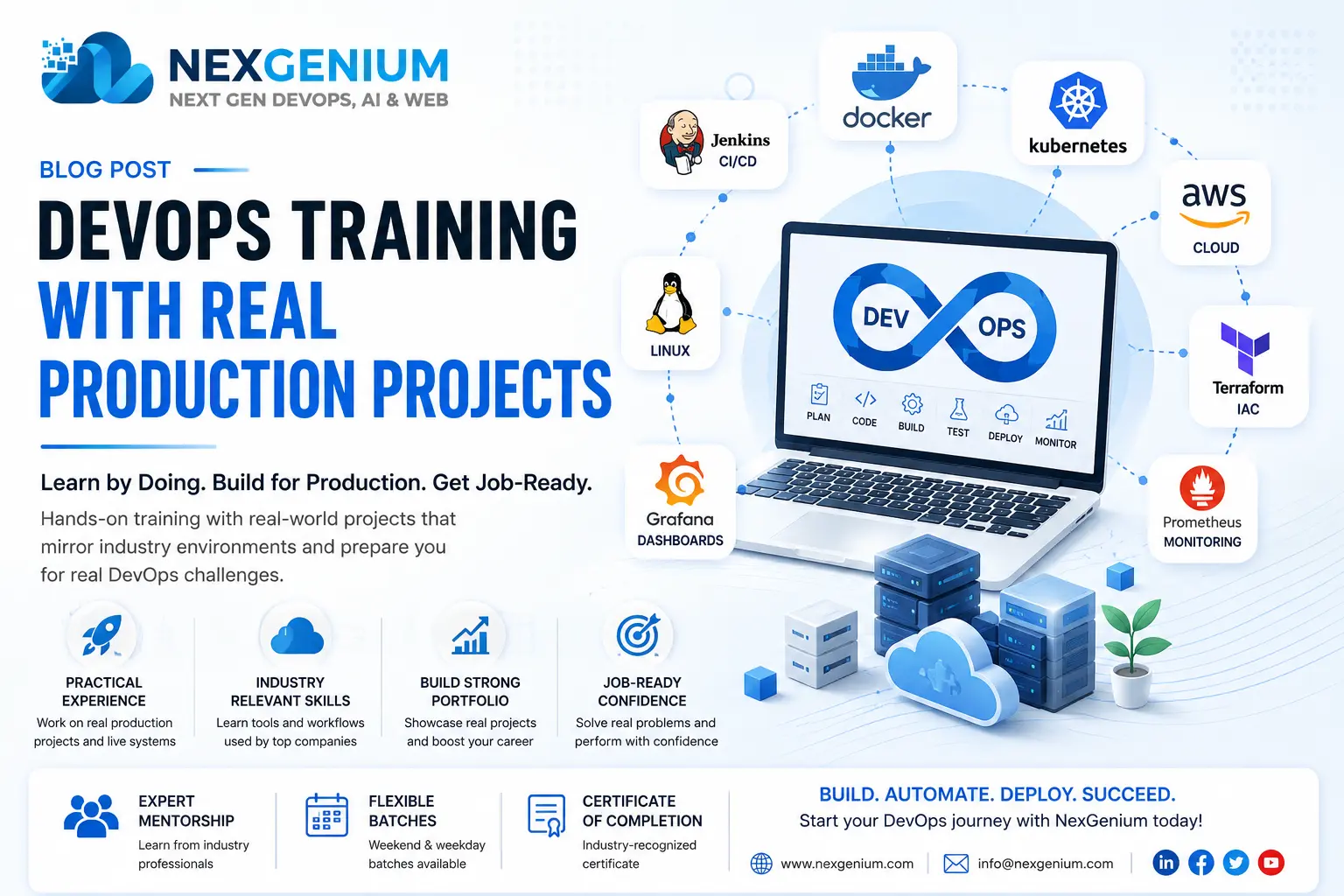
Typical production projects include:
- Deploying applications on AWS
- Building CI/CD pipelines
- Managing Docker containers
- Orchestrating workloads with Kubernetes
- Configuring monitoring dashboards
- Automating infrastructure with Terraform
- Managing Linux servers
- Troubleshooting production incidents
This approach prepares learners for real workplace responsibilities.
Skills You Learn Through Live Projects
Linux Administration
Develop practical skills in:
- Server management
- User and permission management
- Shell scripting
- Process monitoring
- Security hardening
- Log analysis
Linux remains the foundation of most cloud environments.
Cloud Infrastructure
Gain experience with modern cloud platforms including:
- Amazon Web Services (AWS)
- Microsoft Azure
- Google Cloud Platform (GCP)
You'll learn how to deploy, configure, and manage scalable cloud infrastructure.
Docker Containerization
Understand how to:
- Build Docker images
- Create containers
- Use Docker Compose
- Manage volumes and networking
- Optimize application deployments
Containerization ensures consistency across development and production environments.
Kubernetes Orchestration
Work with enterprise-grade Kubernetes clusters by learning:
- Pods
- Deployments
- Services
- Ingress
- ConfigMaps
- Secrets
- Auto Scaling
Kubernetes is now one of the most sought-after DevOps skills.
CI/CD Automation
Automate software delivery using:
- Jenkins
- GitHub Actions
- GitLab CI/CD
- Azure DevOps
Learn how organizations deploy applications multiple times a day with confidence.
Infrastructure as Code (IaC)
Automate infrastructure provisioning using:
- Terraform
- Ansible
- CloudFormation
Infrastructure as Code improves consistency, scalability, and operational efficiency.
Monitoring & Logging
Learn proactive monitoring using:
- Prometheus
- Grafana
- ELK Stack
- Loki
Understand how to identify performance issues before they affect users.
Real-World Project Examples
During live project training, you may work on scenarios such as:
Project 1
Deploy a scalable web application using Docker and Kubernetes.
Project 2
Build an automated CI/CD pipeline with Jenkins and GitHub.
Project 3
Provision cloud infrastructure using Terraform.
Project 4
Configure monitoring dashboards with Prometheus and Grafana.
Project 5
Secure a production Linux server using best practices.
Project 6
Deploy a highly available application behind a load balancer.
These projects closely reflect the responsibilities of modern DevOps engineers.
Benefits of Learning Through Production Projects
Build Practical Confidence
Hands-on experience helps you understand how technologies work together in real environments.
Improve Problem-Solving Skills
Production systems require critical thinking and troubleshooting.
You'll learn how to analyze logs, identify root causes, and resolve issues efficiently.
Create a Strong Portfolio
Real projects demonstrate your abilities better than certificates alone.
A portfolio showcasing production-level deployments can significantly improve your chances during interviews.
Become Job-Ready
Employers prefer candidates who can contribute from day one.
Production project experience reduces onboarding time and makes you a valuable team member.
Who Should Join?
This training is ideal for:
- Working Professionals
- System Administrators
- Linux Administrators
- Cloud Engineers
- Software Developers
- Technical Support Engineers
- Fresh Graduates
- Career Switchers
Whether you're beginning your journey or upgrading your skills, live project training accelerates your career growth.
Why Companies Prefer Practical Experience
Recruiters often ask questions like:
- Have you deployed applications on AWS?
- Have you managed Kubernetes clusters?
- Can you troubleshoot production issues?
- Have you created CI/CD pipelines?
- Have you automated infrastructure?
Practical experience gives you real answers backed by real work.
Why Learn with NexGenium?
At NexGenium, our programs are built around practical learning and real-world implementation.
What You'll Get
- Live Production Projects
- Real Cloud Infrastructure
- One-to-One Mentorship
- Weekend & Flexible Batches
- Industry Expert Trainers
- Resume & LinkedIn Optimization
- Mock Interviews
- Career Guidance
- Placement Assistance
We focus on helping learners develop the confidence and skills required to work in modern DevOps environments.
Success Beyond Certification
Certificates demonstrate that you've completed a course.
Production experience demonstrates that you can solve real business problems.
Organizations hire professionals who can manage infrastructure, automate deployments, improve reliability, and deliver value—not just explain concepts.
That's why practical experience is one of the strongest investments you can make in your DevOps career.
Final Thoughts
The technology landscape is evolving rapidly, and companies need professionals who can confidently work with cloud infrastructure, automation, and production systems.
Learning through real production projects bridges the gap between theory and practical application, making you better prepared for interviews, promotions, and challenging technical roles.
Whether you're an aspiring DevOps Engineer or an experienced IT professional looking to upskill, hands-on project experience will help you stand out in today's competitive job market.
Ready to Work on Real Production Projects?
Join NexGenium's industry-focused DevOps training program and gain practical experience with Linux, AWS, Docker, Kubernetes, CI/CD pipelines, monitoring, automation, and real cloud infrastructure.
Learn by Building. Practice on Live Projects. Become Industry Ready with NexGenium. 🚀
About NexGenium
Senior Solutions EngineersNexGenium technical practitioners providing production-grade engineering, cloud infrastructure solutions, and industry training.