
DevSecOps: Security Throughout the CI/CD Pipeline | 2026
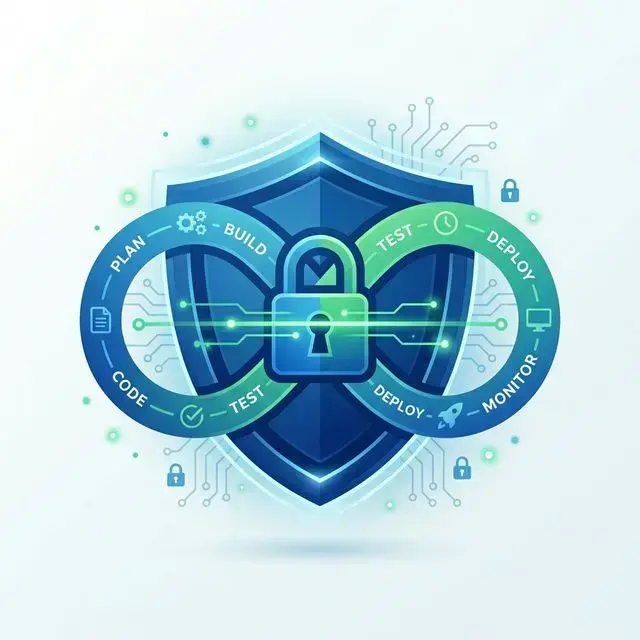
DevSecOps: Integrating Security Into the CI/CD Pipeline
In traditional software development, security testing was treated as an isolated audit at the very end of the release cycle. This reactive model resulted in costly deployment delays, last-minute architectural rewrites, and unpatched production vulnerabilities.
DevSecOps (Development, Security, and Operations) transforms security from a bottleneck into an automated, continuous process embedded directly within the software delivery lifecycle. By 'shifting left,' security guardrails run automatically inside every pull request and CI/CD pipeline step.
What Is DevSecOps?
DevSecOps is the cultural, procedural, and technological integration of security practices into every stage of application development and IT operations. Instead of relying on periodic manual penetration tests, DevSecOps uses automated security tooling, policy-as-code, and continuous vulnerability monitoring.
DevSecOps vs DevOps
| Aspect | DevOps | DevSecOps |
|---|---|---|
| Primary Focus | Speed, deployment velocity, continuous delivery | Speed balanced with continuous automated security |
| Security Testing | Post-build or pre-release manual checks | Automated inline checks in every CI/CD commit |
| Responsibility | Development and Operations teams | Shared responsibility across Dev, Sec, and Ops |
Security Throughout the CI/CD Pipeline
A mature DevSecOps pipeline embeds automated security controls across eight core stages:
Source Code Security
Enforce pre-commit hooks that format code, enforce linting rules, and prevent engineers from committing raw credentials or private keys.
Dependency Scanning
Scan open-source software dependencies (SCA - Software Composition Analysis) to catch vulnerable packages (e.g., CVEs in npm, PyPI, or Maven packages) automatically.
SAST (Static Application Security Testing)
Analyze application source code for security flaws—such as SQL injection, XSS, and buffer overflows—before code is compiled.
Secrets Detection
Run automated scanners (Gitleaks, TruffleHog) in CI pipelines to prevent hardcoded passwords, tokens, and SSH keys from entering Git history.
Container Security
Scan Docker base images (Trivy, Clair) for known vulnerabilities and ensure containers execute under non-root user accounts.
Infrastructure Security
Scan Infrastructure as Code templates (Checkov, tfsec) for cloud misconfigurations—such as open S3 buckets or permissive security groups—before deployment.
DAST (Dynamic Application Security Testing)
Run automated security testing tools (OWASP ZAP) against running staging instances to identify runtime vulnerabilities.
Runtime Monitoring
Deploy Runtime Application Self-Protection (RASP) and eBPF-based security monitoring to detect anomalous container activity in production.
DevSecOps Pipeline Architecture
Here is how security automated controls integrate into the continuous delivery pipeline:
Developer Commit → Pre-Commit Hooks → SAST & Dependency Scan → Container & IaC Scan → Artifact Signing → DAST in Staging → Production Runtime Defense
To learn how to design automated deployment pipelines, explore our comprehensive guides on CI/CD Pipeline Architecture and CI/CD Pipeline Optimization.
DevSecOps Tools
- SAST: SonarQube, Semgrep, Checkmarx
- SCA & Dependency Scanning: Snyk, OWASP Dependency-Check
- Secrets Detection: Gitleaks, TruffleHog, HashiCorp Vault
- Container Scanning: Trivy, Grype, Anchore Engine
- IaC Security: Checkov, tfsec, Kube-linter
- DAST: OWASP ZAP, Burp Suite Enterprise
Common DevSecOps Challenges
- Pipeline Friction: Slow security scans that block developer deployment velocity. Solution: Run lightweight scans inline and heavy scans asynchronously.
- False Positive Overload: Noise from uncurated scanners. Solution: Tune rule engines and filter non-exploitable vulnerabilities.
- Cultural Resistance: Developers viewing security as a blocker. Solution: Provide actionable remediation guidance within developer pull requests.
DevSecOps Best Practices
- Shift security left into IDEs and pre-commit checks.
- Treat security rules as code stored in Git repositories.
- Automate secret rotation and use centralized KMS managers.
- Maintain an accurate Software Bill of Materials (SBOM).
DevSecOps Checklist
- ☐ Pre-commit secret scanning hooks enabled
- ☐ SAST scanning configured in CI pull requests
- ☐ Dependency vulnerability checks (SCA) active
- ☐ Container image scanning enforced before image push
- ☐ IaC security policies (Checkov/tfsec) blocking bad manifests
- ☐ Secrets managed outside code repositories
- ☐ DAST scans scheduled against staging endpoints
- ☐ Production runtime security & audit logging active
Frequently Asked Questions
What is DevSecOps?
DevSecOps is the practice of integrating automated security checks and security culture directly into the DevOps software development lifecycle.
How does DevSecOps differ from traditional security?
Traditional security tests software manually at the end of development. DevSecOps automates security checks continuously at every code commit and deployment step.
What are SAST and DAST?
SAST (Static Application Security Testing) analyzes source code without executing it. DAST (Dynamic Application Security Testing) tests running applications from the outside to discover vulnerabilities.
Enterprise Security & DevOps Services
Need assistance hardening your software delivery pipelines? Learn more about our AI & Cloud Consulting Services and Managed DevOps & Cloud Services. For learners seeking hands-on skills, check out our DevOps Training Programs.
About NexGenium Security Team
DevSecOps & Cloud Security SpecialistsCybersecurity practitioners and DevSecOps engineers focused on automated vulnerability scanning, zero-trust policies, and container runtime defense.