
How to Start Your Career as a DevOps Engineer, Linux Administrator, or System Administrator in 2026
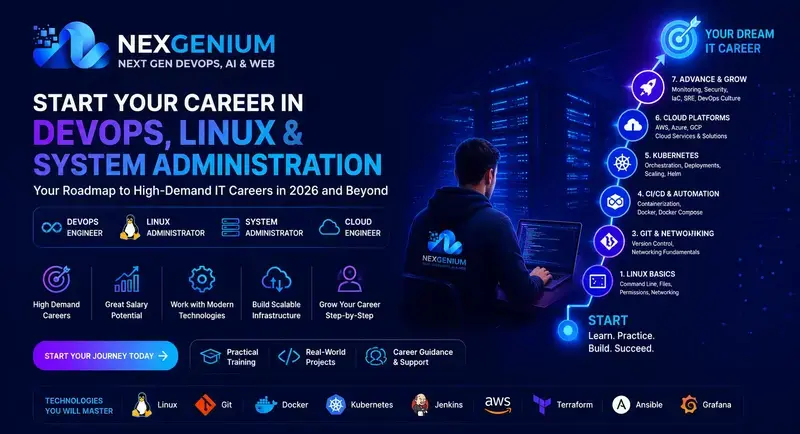
How to Start Your Career as a DevOps Engineer, Linux Administrator, or System Administrator
The IT industry offers numerous career opportunities, but some of the most stable and high-demand roles today are DevOps Engineer, Linux Administrator, System Administrator, Cloud Engineer, and Infrastructure Engineer.
As businesses continue migrating to cloud platforms and adopting automation, professionals with Linux, cloud, and DevOps skills are becoming increasingly valuable.
If you're a student, fresher, or IT professional looking to enter this field, this roadmap will guide you step-by-step.
Understanding the Different Career Paths
Before choosing a career path, it's important to understand how these roles are connected.
Linux Administrator
Manages Linux servers, system performance, security, user access, and troubleshooting.
System Administrator
Responsible for server management, networking, backups, monitoring, and IT infrastructure maintenance.
DevOps Engineer
Focuses on automation, CI/CD pipelines, cloud infrastructure, containerization, and deployment processes.
Cloud Engineer
Designs and manages cloud-based infrastructure on AWS, Azure, or Google Cloud.
All these roles share a common foundation and often evolve into one another as professionals gain experience.
Step 1: Learn Linux Fundamentals
Linux is the foundation of almost every modern infrastructure environment.
Important Topics:
- Linux Commands
- File Management
- User & Group Management
- Permissions & Ownership
- Process Management
- Package Installation
- Cron Jobs
- SSH & Remote Access
Popular Linux Distributions:
- Ubuntu
- Rocky Linux
- Debian
- CentOS
Strong Linux knowledge is essential for system administration and DevOps careers.
Step 2: Learn Networking Basics
Every infrastructure professional should understand networking fundamentals.
Key Topics:
- IP Addressing
- DNS
- HTTP & HTTPS
- TCP/IP
- Firewalls
- Reverse Proxy
- Load Balancers
- VPN Concepts
Networking skills help troubleshoot server and application connectivity issues.
Step 3: Learn Git & Version Control
Version control is a critical skill for modern IT teams.
Learn:
- Git Basics
- Branching Strategies
- Merging & Conflict Resolution
- GitHub
- GitLab
Git is used in almost every DevOps and software development environment.
Step 4: Learn Cloud Computing
Cloud platforms have become the standard for modern infrastructure.
Most Popular Platforms:
- AWS
- Microsoft Azure
- Google Cloud Platform
Essential Services:
- Virtual Machines
- Object Storage
- Networking
- Security Groups
- Load Balancers
- Identity & Access Management
Cloud knowledge significantly increases career opportunities and salary potential.
Step 5: Master Server Administration
A good administrator understands how to maintain production servers.
Learn:
- Nginx
- Apache
- SSL Installation
- Database Management
- Backup Strategies
- Log Analysis
- Monitoring
This knowledge forms the backbone of infrastructure management.
Step 6: Learn Docker
Containers have transformed modern application deployment.
Topics to Learn:
- Docker Images
- Containers
- Dockerfile
- Docker Compose
- Networking
- Volumes
Docker is now considered a mandatory skill for DevOps professionals.
Step 7: Learn CI/CD Pipelines
Continuous Integration and Continuous Deployment automate software delivery.
Popular Tools:
- Jenkins
- GitHub Actions
- GitLab CI/CD
- Azure DevOps
Benefits:
- Faster Deployments
- Reduced Errors
- Automated Testing
- Improved Reliability
Step 8: Learn Kubernetes
Kubernetes is the leading container orchestration platform.
Important Concepts:
- Pods
- Deployments
- Services
- Ingress
- ConfigMaps
- Secrets
- Helm Charts
Kubernetes skills are highly sought after by employers worldwide.
Step 9: Learn Infrastructure Automation
Automation is a core requirement for DevOps engineers.
Popular Tools:
- Terraform
- Ansible
- CloudFormation
Benefits:
- Faster Provisioning
- Infrastructure Consistency
- Reduced Manual Errors
- Scalable Deployments
Step 10: Learn Monitoring & Security
Reliable infrastructure requires continuous monitoring and security management.
Monitoring Tools:
- Prometheus
- Grafana
- ELK Stack
- Loki
Security Skills:
- IAM Management
- SSL/TLS
- Secrets Management
- Vulnerability Scanning
Organizations prioritize professionals who understand both operations and security.
Certifications That Can Help
Although practical skills matter most, certifications can strengthen your resume.
Recommended Certifications:
- AWS Certified Cloud Practitioner
- AWS Solutions Architect Associate
- RHCSA (Red Hat Certified System Administrator)
- Docker Certified Associate
- Kubernetes Administrator (CKA)
- Terraform Associate
Beginner Project Ideas
Employers value practical experience more than theory.
Projects You Can Build:
- Linux Web Server Setup
- Personal Portfolio Deployment
- Dockerized Application
- Jenkins CI/CD Pipeline
- Kubernetes Application Deployment
- AWS Infrastructure Automation
Adding these projects to your portfolio significantly improves job prospects.
Common Career Progression
Entry Level
- Linux Support Engineer
- Junior System Administrator
- Technical Support Engineer
Mid-Level
- Linux Administrator
- System Administrator
- Cloud Engineer
Advanced Level
- DevOps Engineer
- Site Reliability Engineer (SRE)
- Platform Engineer
- Cloud Architect
Skills Employers Look For in 2026
Most companies hiring DevOps and Infrastructure professionals look for:
✅ Linux Administration
✅ Networking
✅ AWS or Azure
✅ Docker
✅ Kubernetes
✅ CI/CD Pipelines
✅ Git
✅ Terraform
✅ Monitoring Tools
✅ Problem-Solving Skills
Why Learn with NexGenium?
At NexGenium, we focus on practical, industry-oriented training that prepares students and professionals for real-world infrastructure and DevOps roles.
What You'll Get:
- Live Industry Projects
- Linux Administration Training
- Cloud & AWS Labs
- Docker & Kubernetes Practice
- CI/CD Pipeline Setup
- Resume Building Assistance
- Mock Interviews
- Career Guidance
Our programs are designed to help learners become job-ready and confident in managing modern IT infrastructure.
Final Thoughts
Whether your goal is to become a Linux Administrator, System Administrator, Cloud Engineer, or DevOps Engineer, the key to success is building a strong foundation in Linux, networking, cloud computing, and automation.
The demand for skilled infrastructure professionals continues to grow as organizations embrace cloud technologies and DevOps practices.
Start learning, build projects, gain practical experience, and continuously improve your skills. The opportunities in DevOps and system administration have never been better.
Ready to Start Your IT Career?
Join NexGenium's industry-focused training programs and gain the practical skills required to become a Linux Administrator, System Administrator, Cloud Engineer, or DevOps Engineer.
Learn. Practice. Deploy. Get Hired. 🚀
About NexGenium Team
Senior Solutions EngineersNexGenium technical practitioners providing production-grade engineering, cloud infrastructure solutions, and industry training.