DevOps Roadmap 2026: Complete Guide for Beginners
DevOps Roadmap 2026: Complete Guide for Beginners
DevOps has transformed from an industry buzzword into the standard operating model for modern software engineering and cloud infrastructure. As organizations scale cloud-native microservices, adopt automated deployment pipelines, and integrate AI into operations (AIOps), the demand for skilled DevOps engineers, Site Reliability Engineers (SREs), and Platform Engineers continues to surge in 2026.
However, breaking into DevOps can feel overwhelming due to the vast ecosystem of tools and technologies. Should you learn Docker before Kubernetes? How deep should your Linux knowledge be? Do you need to master multiple cloud providers?
This comprehensive DevOps Roadmap for 2026 provides a structured, step-by-step learning progression designed for beginners and IT professionals transitioning into DevOps. Rather than memorizing endless tools, this guide focuses on fundamental principles, practical skills, and real-world workflows.
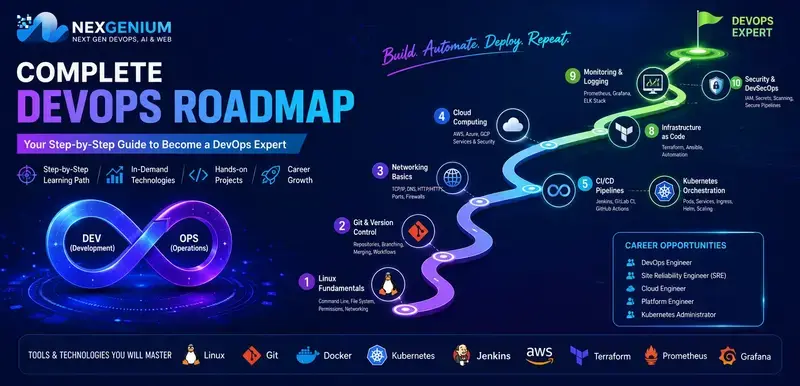
🚀 The 2026 DevOps Learning Progression
Already comfortable with the fundamentals? Continue with our Advanced DevOps Roadmap 2026: Skills, Tools & Projects.
Step 1: Learn Linux Fundamentals & Command Line
Linux powers the vast majority of cloud servers, containers, and production infrastructure worldwide. Operating comfortably inside a Linux terminal is non-negotiable for DevOps engineers.
Core Linux Commands & File Systems
Master essential commands for file management, permissions, and searching: ls, cd, chmod, chown, find, grep, sed, and awk.
Need help getting started? Read our guide on Top Linux Commands for Beginners.
Process & Package Management
Understand background processes, system services (systemctl, journalctl), memory allocation (top, htop), and package managers (apt, yum, dnf).
Practice environment: Follow our guide to Install Ubuntu on Windows VM.
Step 2: Understand Computer Networking & Security Basics
DevOps engineers troubleshoot connectivity between microservices, load balancers, firewalls, and cloud subnets. A solid grasp of networking fundamentals is critical.
Step 3: Master Version Control with Git
Git is the source of truth for modern software development and Infrastructure as Code (GitOps). Every change to code, configuration, or deployment manifests should pass through Git.
Git Fundamentals
Commits, branching strategies, staging areas, remote tracking, and log inspection.
Advanced Workflows
Rebase vs Merge, cherry-picking, resolving merge conflicts, and interactive rebasing.
Collaboration Platforms
Pull/Merge Requests, code reviews, branch protection rules, and release tags on GitHub/GitLab.
Step 4: Master CI/CD Pipeline Automation
Continuous Integration and Continuous Deployment (CI/CD) pipelines automate the journey of software from code commit to production deployment. CI/CD reduces human error and accelerates release speed.
Key Tools & Principles to Learn
- CI/CD Engines: GitHub Actions, GitLab CI, Jenkins, and Azure Pipelines.
- Automated Testing: Unit tests, integration tests, static code analysis (SonarQube), and security scanning.
- Artifact Management: Storing compiled binaries, Docker images, and Helm charts in central registries.
- Deployment Strategies: Rolling deployments, Blue-Green releases, and Canary deployments.
Explore architecture patterns in our CI/CD Pipeline Architecture Guide (2026).
Step 5: Master Containerization with Docker
Containers package application code, runtimes, system tools, and dependencies into lightweight, standalone units. Docker eliminated the age-old "works on my machine" problem.
Docker Core Concepts
- Writing optimized Dockerfiles & multi-stage builds
- Container lifecycle (run, stop, rm, logs, exec)
- Docker networking (bridge, host, overlay)
- Persistent data storage with Docker Volumes
Multi-Container Apps
- Orchestrating microservices using Docker Compose
- Environment variable management
- Container health checks & restart policies
- Pushing images to AWS ECR and Docker Hub
Not sure whether to start with Docker or Kubernetes? Read our decision guide: Docker vs Kubernetes: What Should You Learn First in 2026?.
Step 6: Learn Container Orchestration with Kubernetes
Running containers at enterprise scale requires automation for scheduling, auto-scaling, load balancing, and self-healing. Kubernetes is the undisputed industry standard for container orchestration.
1. Kubernetes Objects & Architecture
Learn Pods, Deployments, ReplicaSets, Services (ClusterIP, NodePort, LoadBalancer), ConfigMaps, and Secrets. Dive deep into Control Plane components (API Server, etcd, Scheduler) and Worker Nodes (Kubelet, Kube-Proxy).
Deep dive: Read Docker & Kubernetes Architecture Explained.
2. Ingress & Helm Package Management
Configure NGINX Ingress Controllers for HTTP routing, manage SSL/TLS certificates, and package Kubernetes manifests using Helm charts.
3. Production Best Practices & GitOps
Set up Horizontal Pod Autoscaling (HPA), Resource Requests/Limits, RBAC, Network Policies, and continuous delivery via ArgoCD or Flux.
Production guide: Read Kubernetes in Production: Best Practices Guide.
Step 7: Master Cloud Computing Platforms
Modern DevOps is intrinsically connected to cloud infrastructure. Focus on mastering one major cloud provider (AWS, Azure, or GCP) deeply before expanding to multi-cloud strategies.
AWS (Amazon Web Services)
EC2, S3, VPC, IAM, EKS, RDS, CloudWatch, Lambda, Auto Scaling groups.
Microsoft Azure
Azure VMs, Blob Storage, Virtual Networks, Entra ID, AKS, Azure DevOps.
Google Cloud (GCP)
Compute Engine, Cloud Storage, VPC, IAM, GKE, Cloud Run, BigQuery.
Step 8: Implement Infrastructure as Code (IaC)
Manual cloud console clicks create configuration drift and human errors. Infrastructure as Code (IaC) allows you to define cloud servers, networks, and databases using declarative code templates.
Infrastructure Provisioning: Terraform
Learn HCL syntax, Terraform state files, modules, providers, variables, and automated plan/apply workflows to build reproducible cloud environments.
Configuration Management: Ansible
Automate application installation, system updates, configuration changes, and security patches across hundreds of servers using YAML playbooks and agentless SSH connection.
Step 9: Observability, Monitoring & Log Aggregation
Deploying applications is only half the battle. In 2026, real-time observability (metrics, logs, traces) is mandatory to guarantee zero downtime and detect production anomalies quickly.
| Domain | Industry Standard Tools | Core Objective |
|---|---|---|
| Metrics Monitoring | Prometheus, Grafana, Datadog | Track CPU, Memory, latency, throughput, and error rates. |
| Log Aggregation | ELK Stack (Elasticsearch, Logstash, Kibana), Loki | Centralize server logs for quick error analysis and auditing. |
| Distributed Tracing | OpenTelemetry, Jaeger, Zipkin | Trace HTTP requests across complex microservice boundaries. |
| AIOps & Alerting | PagerDuty, Alertmanager, Opsgenie | Automate incident notification and AI-driven anomaly alerts. |
Step 10: Integrate DevSecOps & Security Automation
DevSecOps shifts security left by integrating automated security checks directly into the early stages of CI/CD pipelines rather than treating security as an afterthought.
Static Code & Secret Scanning
Use tools like SonarQube, Trivy, and GitGuardian to detect hardcoded credentials and vulnerable code libraries before deployment.
Container & Infrastructure Security
Scan base Docker images for vulnerabilities, enforce Kubernetes Pod Security Standards, and manage secrets using HashiCorp Vault or AWS Secrets Manager.
Recommended DevOps Learning Milestones
Beginner Level
- ✅ Linux Administration Basics
- ✅ Shell Scripting (Bash)
- ✅ Computer Networking Fundamentals
- ✅ Git & GitHub Version Control
- ✅ Basic Cloud Services (AWS EC2/S3)
Intermediate Level
- ✅ Docker & Multi-Container Setup
- ✅ CI/CD Pipeline Build (GitHub Actions)
- ✅ Infrastructure as Code (Terraform)
- ✅ Prometheus & Grafana Monitoring
- ✅ Linux Web Servers (NGINX/Apache)
Advanced Level
- ✅ Production Kubernetes (EKS/AKS)
- ✅ GitOps & Continuous Delivery (ArgoCD)
- ✅ DevSecOps Pipeline Integration
- ✅ Cloud Architecture & Multi-Region Failover
- ✅ AIOps & Automated Incident Response
DevOps Career Opportunities & Salary Potential in 2026
DevOps remains one of the highest-paying technical domains. High demand from startups and enterprises means qualified engineers with hands-on project experience enjoy high job security and career mobility.
DevOps Engineer
Automates builds, deployments, and cloud infrastructure.
Site Reliability Engineer (SRE)
Ensures platform uptime, scalability, and performance metrics.
Platform Engineer
Builds Internal Developer Platforms (IDP) for software teams.
DevSecOps Engineer
Integrates automated security and compliance into pipelines.
Accelerate Your DevOps Career with NexGenium
Reading tutorials is a start, but true DevOps mastery requires building real production pipelines, setting up Kubernetes clusters, and deploying cloud infrastructure from scratch.
Ready to Become a Job-Ready DevOps Engineer?
Join NexGenium's industry-led DevOps training program with live production projects, cloud lab access, and 1-on-1 career mentorship.
About NexGenium Team
Senior Solutions EngineersNexGenium technical practitioners providing production-grade engineering, cloud infrastructure solutions, and industry training.